
 Registrati
 Login
Login
Log in or Create account

 Africa
 Territorio e istituzioni
 America Latina
 Osservatorio sul diritto elettorale
 Osservatorio Trasparenza
 Human Rights
 Lavoro Persona Tecnologia
 Osservatorio di Diritto sanitario
 Storico focus
 Riforme istituzionali e forma di governo
FOCUS - Academic Freedom N. 27 - 09/10/2026
From book to screen: rethinking knowledge and constitutional education in the digital era
Abstract [En]: This article examines the transformation of the right to teach and learn in the digital age, drawing on the reflections of several major theorists of media, knowledge and postmodernity, among them Marshall McLuhan, Jean-François Lyotard and Jacques Derrida. The shift from book to screen has profoundly altered the modern concept of knowledge, undermining its claims to universality, linearity and codification. Hypertext and the data economy have monetised the transmission of knowledge, affecting the subjective dimension of freedom. Artificial intelligence represents the latest stage of this transformation and calls for a constitutional reassessment of the socialisation of knowledge. The article offers a critical rethinking of the relationship between technological media and fundamental freedoms.
Titolo: Dal libro allo schermo: ripensare la conoscenza e l’educazione costituzionale nell’era digitale
Abstract [It]: Il contributo analizza la trasformazione del diritto di insegnare e apprendere nell’era digitale alla luce delle teorie di Marshall McLuhan, Jean-François Lyotard e Jacques Derrida. Il passaggio dal libro allo schermo ha modificato radicalmente il concetto moderno di conoscenza, dissolvendone la pretesa di universalità, linearità e codificazione. L’ipertesto e l’economia dei dati hanno prodotto una monetizzazione della trasmissione del sapere, incidendo sulla dimensione soggettiva della libertà. L’intelligenza artificiale rappresenta l’ultima fase di questa evoluzione, imponendo una riflessione costituzionale sulla socializzazione della conoscenza. Il saggio propone una rilettura critica del rapporto tra mezzo tecnico e libertà fondamentale.
Keywords: Freedom of teaching, Hypertext, Digital knowledge, Knowledge monetization, Artificial intelligence
Parole chiave: Libertà di insegnamento, Ipertesto, Conoscenza digitale, Monetizzazione del sapere, Intelligenza artificiale
Table of contents: 1. Introduction: from modern “Encyclopedism” to postmodern digital fragmentation. 2. The freedom to teach and to learn is no longer a civil liberty. 3. Knowledge has disappeared! 3.1. On human knowledge. 3.2. The Modern idea of knowledge. 4. Code and human interaction. 5. Neoliberalism and new forms of knowledge exploitation. 6. Books and knowledge support. 6.1. Education before the book: dictation and copying. Grammar and rhetoric. 6.2. Education after the book: screen and hypertext. 7. Conclusions: AI at the End.
 Scarica il Documento integrale
NUMERO 27 - ALTRI ARTICOLI
-
ITALIA - DOTTRINA
Cittadinanza italiana ed europea. Un film a più tempi con un finale ancora da scrivere
ITALIA - PAPERLegge elettorale: intendersi anzitutto sui criteri
ITALIA - DOTTRINAIl regionalismo di Livio Paladin
-
ITALIA - PAPER
Una legge elettorale per avere una maggioranza e un governo
ITALIA - DOTTRINAL’apprendista istruttore. L’intelligenza artificiale sperimentata nell’ambito dei controlli sulla SCIA edilizia
ITALIA - PAPERIl sistema elettorale nell’era della regressione democratica
-
ITALIA - DOTTRINA
Il RENTRI e la digitalizzazione della tracciabilità: funzione giuridica, struttura e profili critici
ITALIA - DOTTRINAGiudizi di legittimità costituzionale e discrezionalità legislativa: un rallentamento nella “fuga dalle inammissibilità” della Corte?
 STUDI FEDERALISMI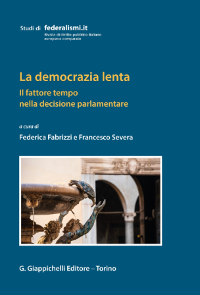
La democrazia lenta. Il fattore tempo nella decisione parlamentare
F. Fabrizzi, F. Severa (a cura di)2026
 disponibile anche in e-Book





Segreteria di redazione
Chiara Arruzzoli; Simone Barbareschi; Alina Iuliana Benea; Andrea Caravita di Toritto; Maria Cristina Carbone; Adriano Dirri; Eleonora Iannario; Giulia Renzi; Giulia Santomauro; Francesco Severa; Sergio Spatola; Giulia Vasino.
E-mail: redazione@federalismi.it
Informazioni generali
Codice etico
Collana "Studi di federalismi.it"
Powered by
Execution time: 26 ms - Your address is 216.73.217.42
09/10/2026
29/06/2026
30/03/2026
20/02/2026
30/01/2026
08/08/2025
30/05/2025
14/04/2025
24/01/2025
01/11/2024
30/08/2024
29/07/2024
03/06/2024
15/03/2024
29/12/2023
04/08/2023
05/06/2023
30/01/2023
09/12/2022
28/10/2022
28/03/2022
02/02/2022
17/01/2022
12/02/2021
18/01/2021
13/11/2020
12/10/2020
17/06/2020
01/06/2020
18/05/2020
04/05/2020
24/04/2020
10/04/2020
27/03/2020
10/04/2020
25/10/2019
27/09/2019
15/04/2019
25/03/2019
14/01/2019
14/12/2018
16/11/2018
09/11/2018
14/09/2018
03/09/2018
22/06/2018
23/02/2018
27/11/2017
02/10/2017